What X-Ray Inspection CANNOT Detect: An Honest Limitations Guide
Food X-ray inspection depends on measurable attenuation contrast, product thickness, material composition and system configuration. Review difficult contaminants, packaging and product geometry, then define controlled sample tests. Low-density materials need product-specific evidence rather than a blanket detection promise.
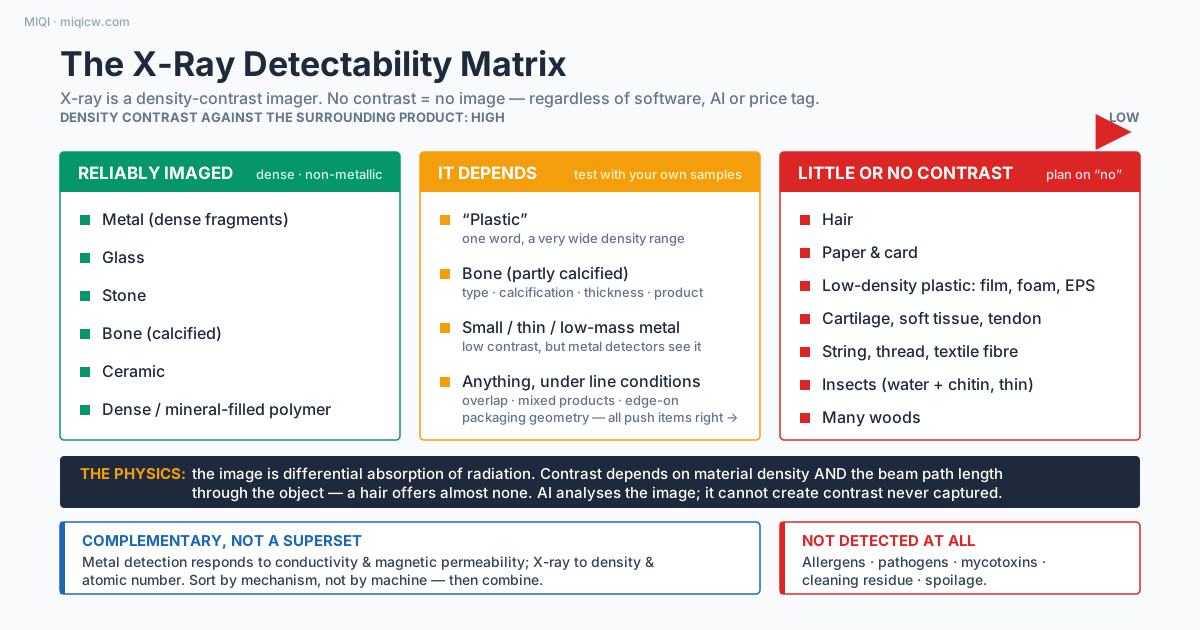
X-ray inspection cannot reliably detect foreign objects whose density is close to that of the surrounding product. The image is formed by differential absorption of radiation — density contrast — so a contaminant that absorbs roughly the same amount of energy as the food around it produces little or no contrast, and therefore little or no image. In practice this affects hair, paper and card, low-density plastics, cartilage and soft tissue, string and fibre, insects, and many types of wood. No amount of software, AI, or detector resolution repeals this: if the contrast is not there, there is nothing to enhance.
These limits belong in the acceptance test for food X-ray inspection systems. Use Metal Detector vs X-Ray Inspection: Which Food Inspection System Fits? when the decision is between electromagnetic metal detection and density-based X-ray inspection, then test representative contaminants in your own packs.
The physics you have to accept before you spend money
An X-ray inspection system is not a foreign-object detector. It is a density-contrast imager that you have decided to use as a foreign-object detector. That distinction sounds pedantic until it costs you a recall.
X-ray contrast depends on attenuation, which is affected by material composition, density, thickness and X-ray energy. A conventional image and a dual-energy acquisition do not contain identical information: dual-energy systems use measurements at different energies to help discriminate materials. Detection must still be validated for the actual fragment, product, orientation and line speed.
Sales conversations collapse those four variables into one word — "plastic" — and that collapse is where most disappointed buyers are created.
Common misconception vs. fact
Misconception: "X-ray catches everything a metal detector catches, plus more. It's the upgrade."
Fact: X-ray and metal detection fail differently, and the failures do not overlap neatly. Metal detection responds to a material's electromagnetic properties — conductivity and magnetic permeability — not its density. X-ray responds to density and atomic number, not conductivity. There are real-world cases where a small, thin, or low-mass metallic fragment presents very little density contrast in the image but is well within the electromagnetic response of a metal detector. Treating X-ray as a strict superset of metal detection is an assumption, not a fact, and it should be tested with your own samples rather than accepted from a brochure.
Misconception: "AI/deep learning solves the low-density problem."
AI can help interpret weak or complex image features, but a claim for low-density plastic requires a test on that material in the actual product. Request detection results and false rejects with sample counts and operating conditions. This article does not establish that all vendor percentages lack independent support.
Misconception: "A more powerful tube / higher resolution will find it."
Changing tube settings, detector pitch or exposure can alter signal-to-noise ratio and spatial resolution. Whether it improves detection depends on the complete system and product. Do not assume that more power always helps, or that higher resolution always adds noise; compare validated performance at the required speed.
Misconception: "The vendor said it detects plastic, so plastic is covered."
Fact: "Plastic" spans a very wide density range. Dense, filled, or mineral-loaded polymers can image well. Thin films, foams, expanded polystyrene, and soft low-density polyolefins can sit close to the grey value of many wet or aerated foods. The word on the datasheet is not the material in your factory.
The contaminant families that give X-ray trouble
Industry content is structurally reticent here — almost every vendor page lists the finds and skips the misses. Here is the honest list, grouped by why they are hard rather than by a fabricated hit rate. We deliberately give no detection percentages below, because any percentage without a stated sample, product matrix, and method is decoration.
Low density relative to product
Hair, paper and card fragments, string, thread, textile fibre, thin plastic film, foam, and many woods. All of these are organic, light, and often thin in the beam direction, which compounds the problem: contrast depends not only on material density but on the path length the beam travels through the object. A hair or a fibre presents almost no path length at all.
Density similar to product
Cartilage and soft bone in poultry and fish, tendon, gristle, and soft tissue generally. These are the classic "it's food-adjacent" contaminants — chemically similar to the matrix they sit in, so the beam barely distinguishes them. Be sceptical of any bone-detection percentage quoted at you; the number is meaningless without knowing the bone type, its calcification, its thickness, and the product it sits in.
Insects and biological matter
Mostly water and chitin, mostly thin, usually inside a product that is also mostly water. The physics is unfavourable.
Chemical and non-physical hazards
Worth stating plainly because it still gets asked: X-ray does not detect allergens, pathogens, mycotoxins, cleaning-chemical residue, or spoilage. It is a physical-contaminant tool. Those hazards belong to your prerequisite programmes, supplier controls, and laboratory testing — not to a machine on the conveyor.
Even a detectable object can become undetectable
The contaminant list is only half the story. The same fragment that images cleanly in a bench test can vanish on your line for reasons that have nothing to do with the contaminant itself.
Product overlap
Two units stacked or touching in the beam create a thick, high-absorption region. A contaminant hiding in that region is competing against a much larger density signal.
Mixed product types in one flow
When the background density varies from pack to pack, any fixed threshold has to be loosened to avoid false rejects — and a loosened threshold is a less sensitive threshold.
Variable product position
Orientation changes both the path through a fragment and its projected area. A beam normal to the broad face of a thin plate traverses its thickness; an edge-on path can be longer but project a narrower feature. Neither orientation is universally easier to detect. Test realistic rotations and positions rather than predicting performance from thickness alone.
Packaging and product geometry
Seals, folds, gussets, metallised film, tray ribs, and headspace all add structure to the image that the analysis has to explain away. Bagged products in particular concentrate mass unevenly.
Dual-energy and other detector configurations may improve material discrimination in selected applications. Manufacturer descriptions are evidence of available approaches, not independent proof that a particular contaminant will be found on your line. Use a sample trial and agreed acceptance limits to compare options.
So what do you actually do about it?
Nothing above argues against X-ray. It argues against buying X-ray as an act of faith. Here is the sequence we walk customers through.
A working checklist
1. Write down your actual contaminant list. Not "foreign objects" — the specific materials, from your own incident history, complaint log, supplier risk, and process map. If a material is on the list because it plausibly enters your process, keep it. If it is on the list because it was on a template, delete it.
2. For each entry, note four things: material, realistic size, realistic thickness/orientation, and which product it would be in. This is the table that determines your technology choice.
3. Sort each entry by mechanism, not by machine. Metallic and electromagnetically responsive → metal detection is the natural first tool. Dense and non-metallic (glass, stone, dense bone, ceramic, dense polymer) → X-ray. Low-density organics (hair, paper, film, fibre, cartilage) → treat as a process-control problem first, and only then ask what inspection can add.
4. Control hair and fibres upstream through suitable personnel hygiene, supplier controls and validated separation where feasible. Screens or filters only help when suitable for the product and hazard. Magnets do not remove ordinary non-magnetic hair or textile fibre. Select controls for the actual hazard.
5. Test with your own product and your own contaminants. Send real product and real seeded samples. Ask for images, not verdicts. Ask what the false-reject rate was during the test and at what threshold. Insist that the test runs at your line speed, with your pack format, and with product overlap if overlap happens in reality.
6. Interrogate every quoted number. Test method, sample size, confidence interval. A vendor who can answer all three is telling you something; a vendor who cannot is telling you something too.
7. Decide the combination, not the machine. Many plants end up with metal detection plus X-ray covering different mechanisms, plus upstream process controls covering what neither can see. That is not a failure of procurement. That is a correct hazard analysis.
Where MIQI fits — and where we will tell you no
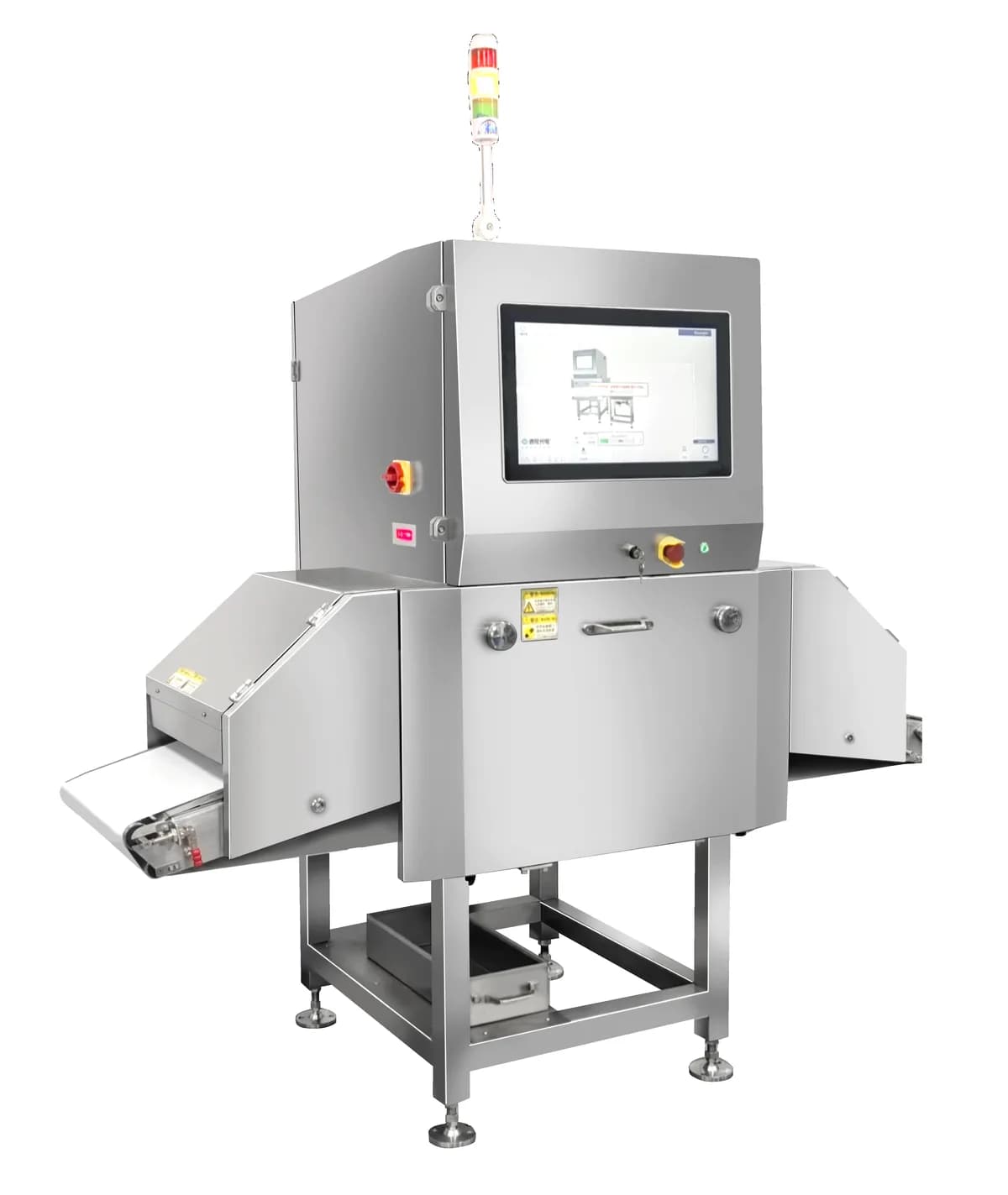
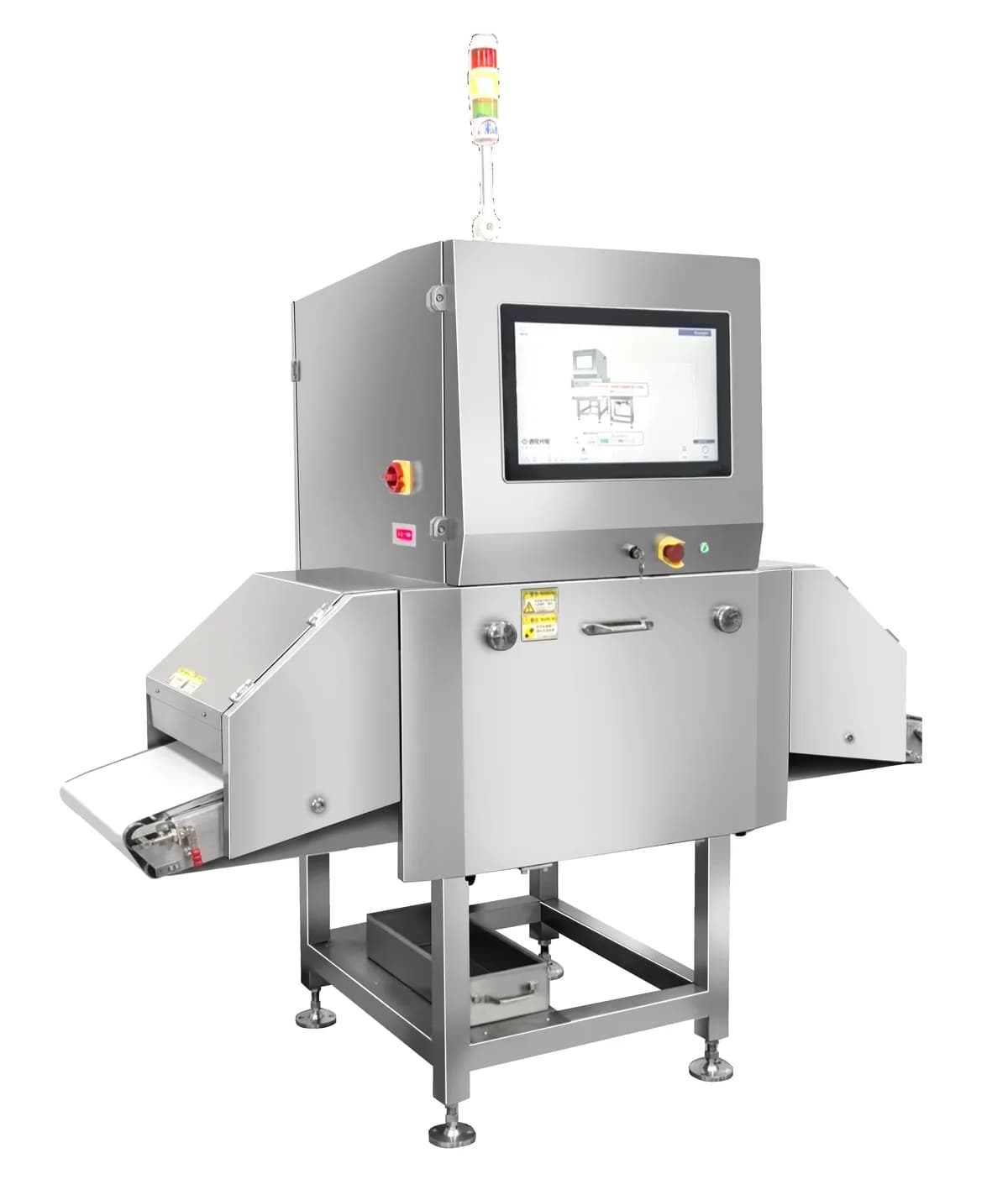
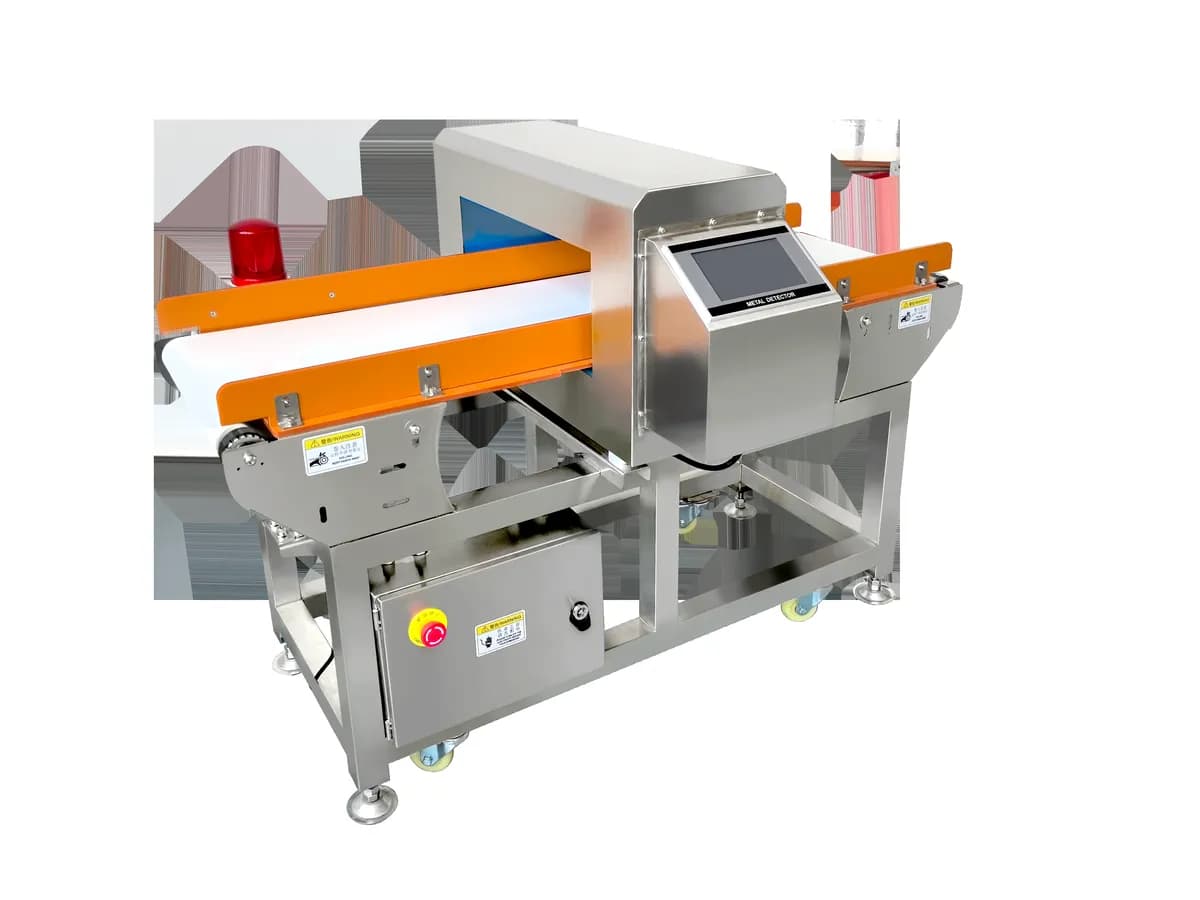
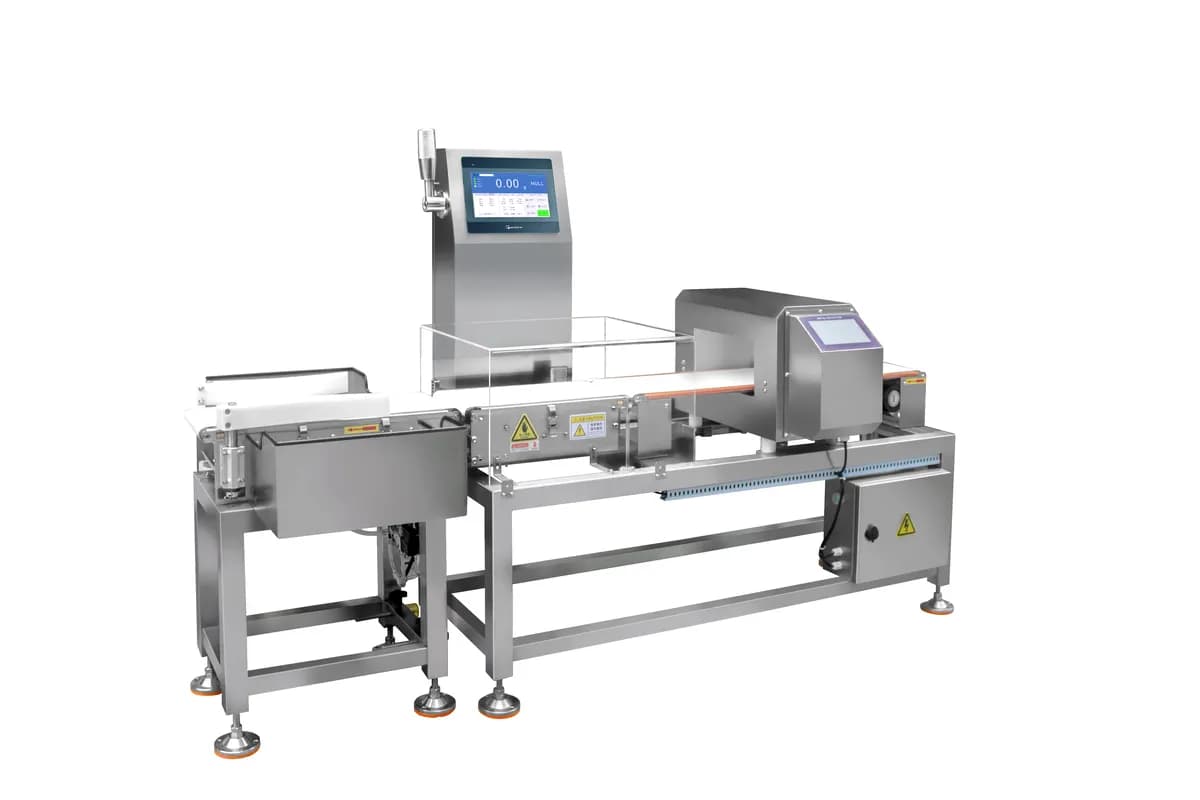
MIQI’s MQ-XR and MQ-XR-P are bagged-product X-ray inspection options; MQ-MD-C addresses metal detection. MQ-MCL4530L2 combines metal detection with checkweighing, not with X-ray, and must not be presented as a combined metal/X-ray system. Select any separate or integrated configuration against the actual sample trial, layout and hazard-control requirements.
One thing we will not do is tell you a machine sees something it does not. We offer free sample testing: send us your product and your seeded contaminants, and we will run them and show you the images — including the ones where the contaminant does not appear. That last category is often the most useful conversation of the whole project, because it tells you where to spend your money instead.
For a straight technical answer on whether X-ray, metal detection, or a combination fits your contaminant list, contact Engineer Cai on WhatsApp at +86 152 1890 9599 or email 897874196@qq.com. Send your product spec, your contaminant list, and your line speed, and we will tell you what we can see — and what we cannot.