
X-Ray Food Inspection Machines
An x-ray food inspection machine finds contaminants that metal detectors cannot: glass, ceramic, stone, and stainless steel, including inside foil and metallized packaging. MIQI's MQ-XR series covers bagged and pouched products up to 10 kg with five size variants, from the MQ-XR-2410 for packs up to 240 × 50 mm to the MQ-XR-7040 for packs up to 700 × 300 mm, with radiation sources from 150 to 350 W depending on model and the high-precision MQ-XR-P sharing the same detection platform. Empty-machine detection accuracy reaches a 0.4 mm stainless steel sphere, 1.0 mm glass, 1.0 mm ceramic, and 0.2 × 5 mm stainless wire at a 0.4 mm detector resolution, with actual in-product performance verified against the customer's material. Conveyors run 10-60 m/min with IP66 washdown protection (IP54 elsewhere), the body is brushed 304 stainless steel, and MIQI's self-developed Sooview software drives inspection from a 21.5-inch touchscreen. Beyond contaminant detection, the same scan checks seal areas and product completeness in one pass.
An x-ray food inspection system is a machine that passes products through a low-energy x-ray beam and analyzes the resulting density image to find foreign objects such as metal, glass, ceramic, stone, and bone, as well as missing pieces or trapped product in seals. Because detection is based on density contrast rather than magnetism or conductivity, x-ray systems inspect products in aluminum foil and metallized film, packaging that blinds conventional metal detectors, and detect non-metal contaminants no metal detector can see.
Food X-Ray Inspection Models
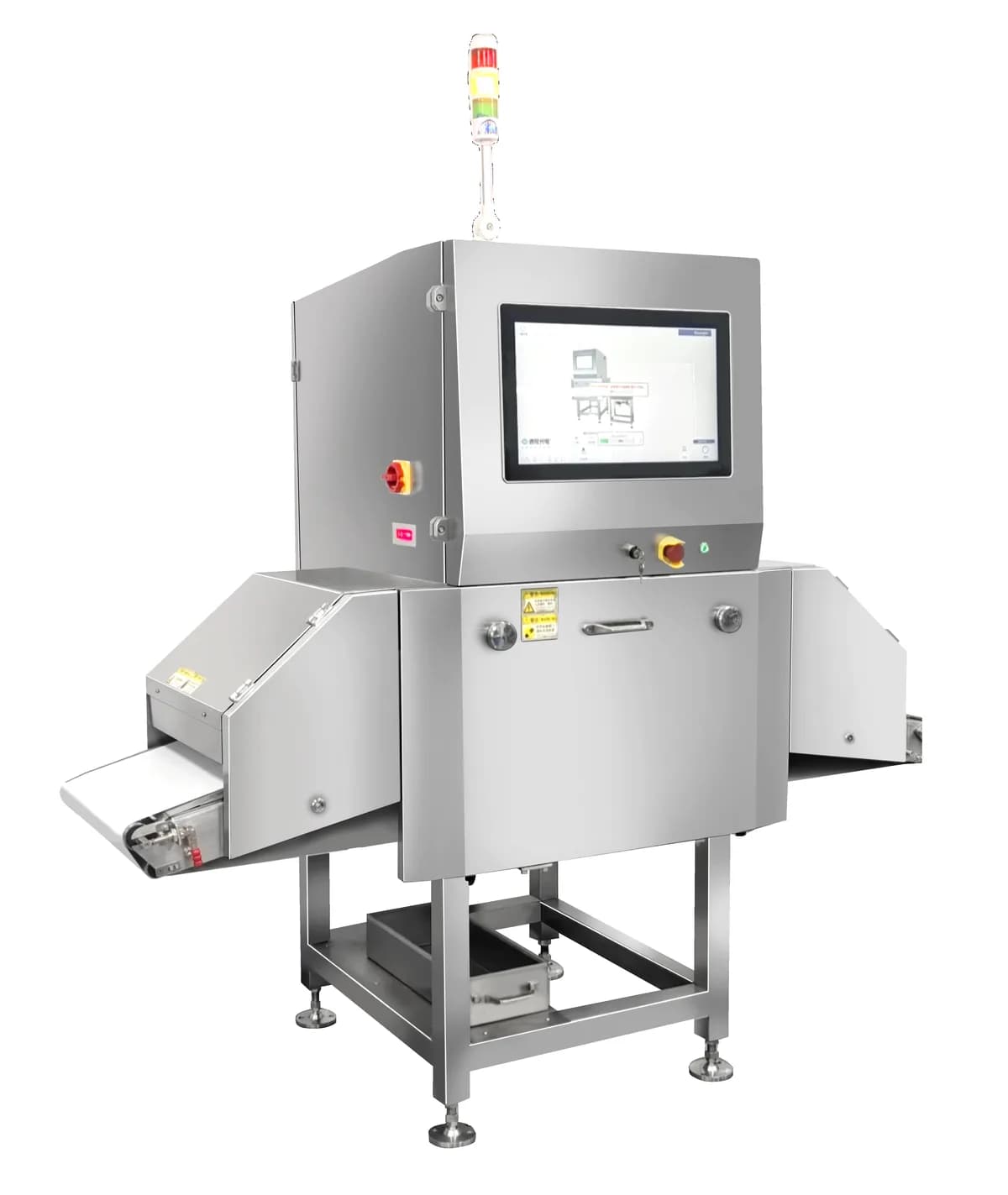
Standard X-Ray Inspection System for Bagged Products
- Empty-machine detection accuracy: SUS ball: 0.4 mm; glass: 1.0 mm; ceramic: 1.0 mm; SUS wire: 0.2 × 5 mm
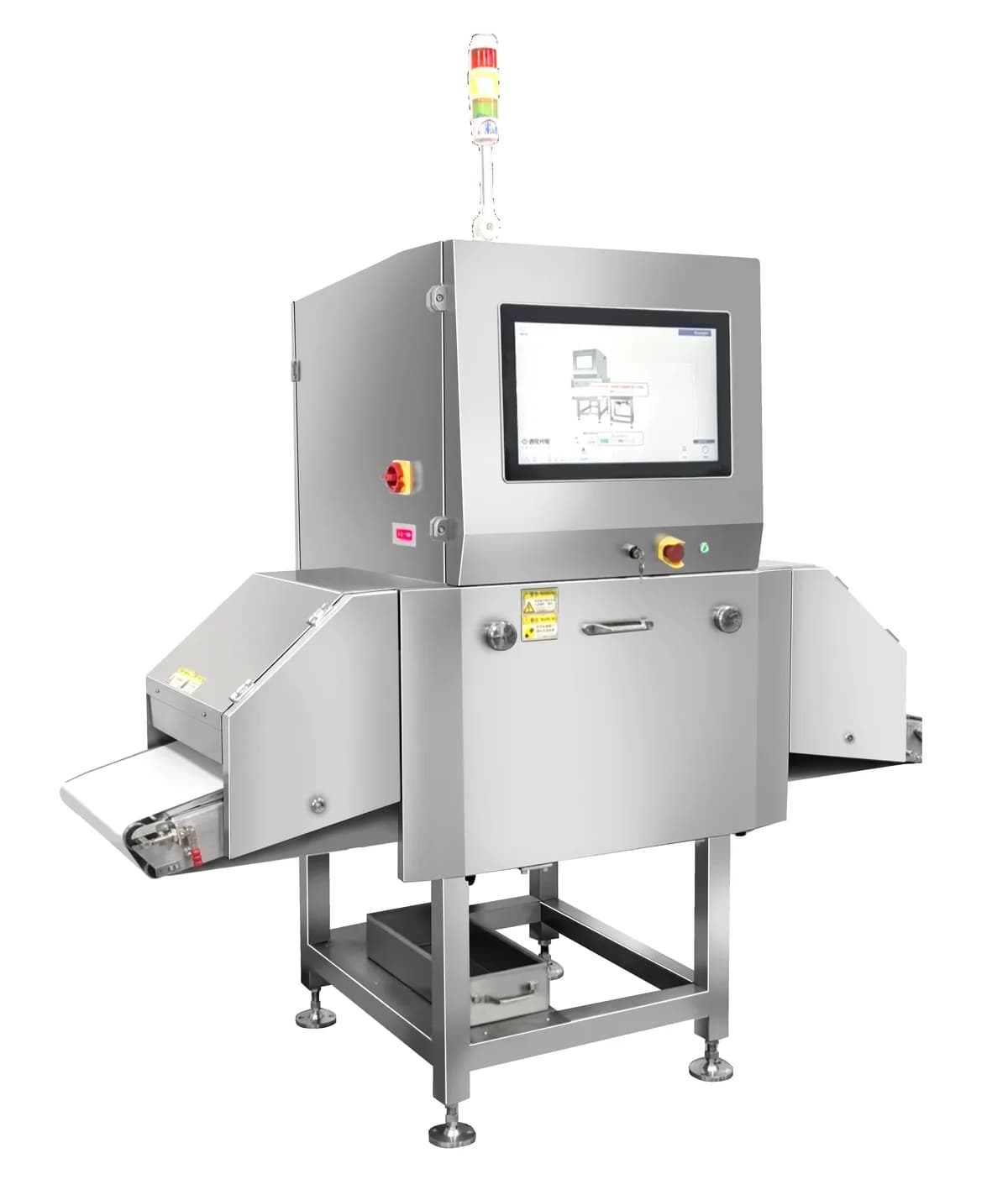
High-Precision X-Ray Inspection System for Bagged Products
- Empty-machine detection accuracy: SUS ball: 0.4 mm; glass: 1.0 mm; ceramic: 1.0 mm; SUS wire: 0.2 × 5 mm
Food X-Ray Inspection Model Comparison
| Model | Max Product Size | Detection Accuracy (empty machine) | Conveyor Speed | Radiation Source |
|---|---|---|---|---|
| MQ-XR-2410 | 240 × 50 mm | SUS ball 0.4 mm; glass 1.0 mm; ceramic 1.0 mm; SUS wire 0.2 × 5 mm | 10-60 m/min | 210 W |
| MQ-XR-4016 | 400 × 120 mm | Same detection platform | 10-60 m/min | 240 W |
| MQ-XR-6030 | 600 × 200 mm | Same detection platform | 10-60 m/min | 240/350 W |
| MQ-XR-6040 | 600 × 300 mm | Same detection platform | 10-60 m/min | 240/350 W |
| MQ-XR-7040 | 700 × 300 mm | Same detection platform | 10-60 m/min | 350 W |
X-Ray Food Inspection Machines: Working Principle
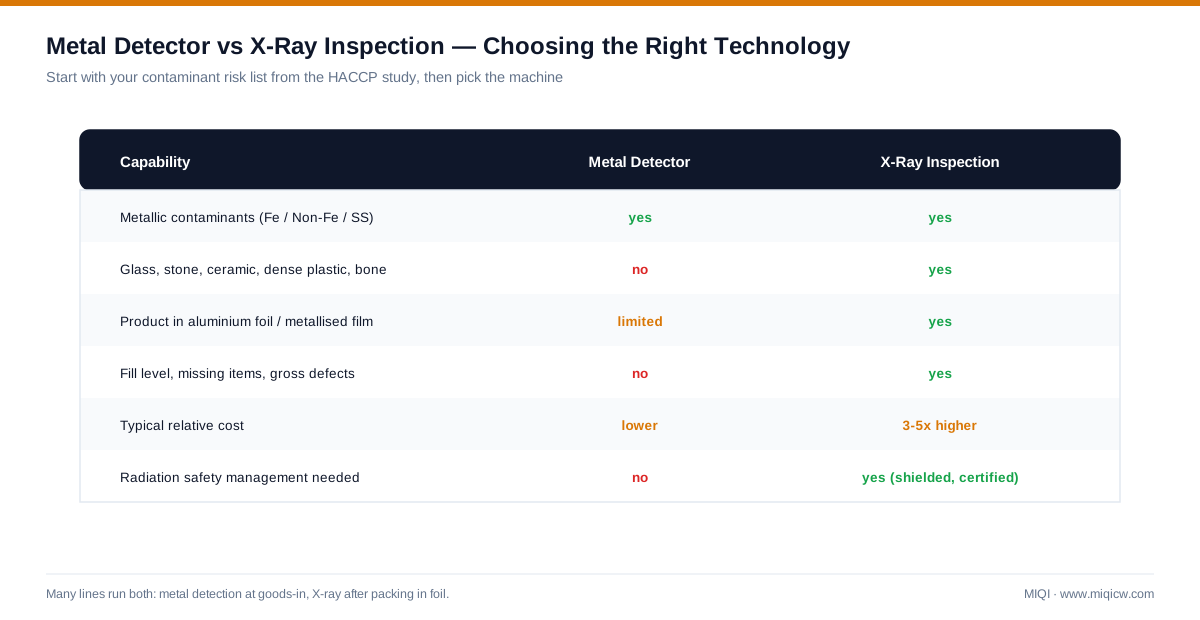
Food X-Ray Machine Price Factors
Food X-ray inspection machine price depends on tunnel and product size, required contaminant challenge, generator and detector configuration, line speed, reject and shielding design, software functions, local radiation-safety requirements and after-sales scope. A quotation should be based on representative product and contaminant tests; no supplier can responsibly guarantee every material from a generic capability list.
Food X-Ray Inspection Buyer Questions
Food X-Ray Inspection Systems
A food X-ray inspection system looks for density contrast in the documented packaged-product window. Product thickness, contaminant material, size, orientation and line speed must be tested; a generic capability chart is not a guarantee.
X-Ray Inspection Machine Price
X ray inspection machine price, x ray machine for food industry price and x ray inspection system price all depend on tunnel size, generator and detector configuration, product challenge, reject design, shielding, software and local radiation-safety obligations. MIQI quotes only after the real scope is defined.
Safety and Detection Limits
Cabinet inspection equipment is designed with shielding and interlocks, but installation and operation remain subject to destination-country rules. Low-density plastics, wood, hair and some bones may be difficult or impossible to detect.
Food X-Ray Inspection Applications
Bagged snacks and flexible packaging
Glass, stone, and metal fragments are detected inside sealed bags at line speed, with seal-area inspection in the same scan.
Foil and metallized packs
X-ray inspects through aluminum foil where metal detectors are blinded, catching stainless steel from 0.4 mm and glass from 1.0 mm (empty-machine rating).
Frozen foods
Dense frozen blocks and pouches up to 10 kg are screened for bone, stone, and metal at 10-60 m/min on IP66 washdown conveyors.
Sauces, sachets, and pouched beverages
Liquid and paste products are checked for glass and ceramic contamination that no other inline technology detects reliably.
Export and audited plants
Retailer and export audit schemes increasingly require x-ray CCPs for glass-risk products; inspection records from the Sooview software support the documentation burden.
Related Contaminant Inspection
Frequently Asked Questions
Is it safe to pass food through an x-ray inspection machine?+
Cabinet X-ray equipment is used for non-destructive inspection of food and other products. Product inspection is different from irradiation for preservation. Operator protection depends on the supplied shielding, interlocks, installation and maintenance. Confirm the applicable radiation-safety requirements and equipment documentation for the destination before use; a website description is not proof of approval.
What contaminants can x-ray inspection detect that metal detectors cannot?+
X-ray can detect contaminants that produce sufficient contrast against the surrounding product, potentially including metal, glass, stone and ceramic. Detectability depends on size, material, orientation, product thickness and packaging. Hair, paper and many low-density plastics may be difficult to detect. Test the defined contaminants inside representative products and verify the reject path; the empty-machine specification is not an in-product guarantee.
What determines an x-ray inspection machine's price?+
Food X-ray inspection price depends on product and tunnel size, detection target, generator and detector configuration, line speed, reject arrangement, shielding, software scope and installation/service responsibilities. Compare quotations against the same sample-test conditions and acceptance criteria. MIQI provides a configuration-based quote rather than a universal market price.
Ship us your product — free on-machine accuracy test with video proof
Free sample testing · OEM & custom design · 2-year warranty · Worldwide shipping