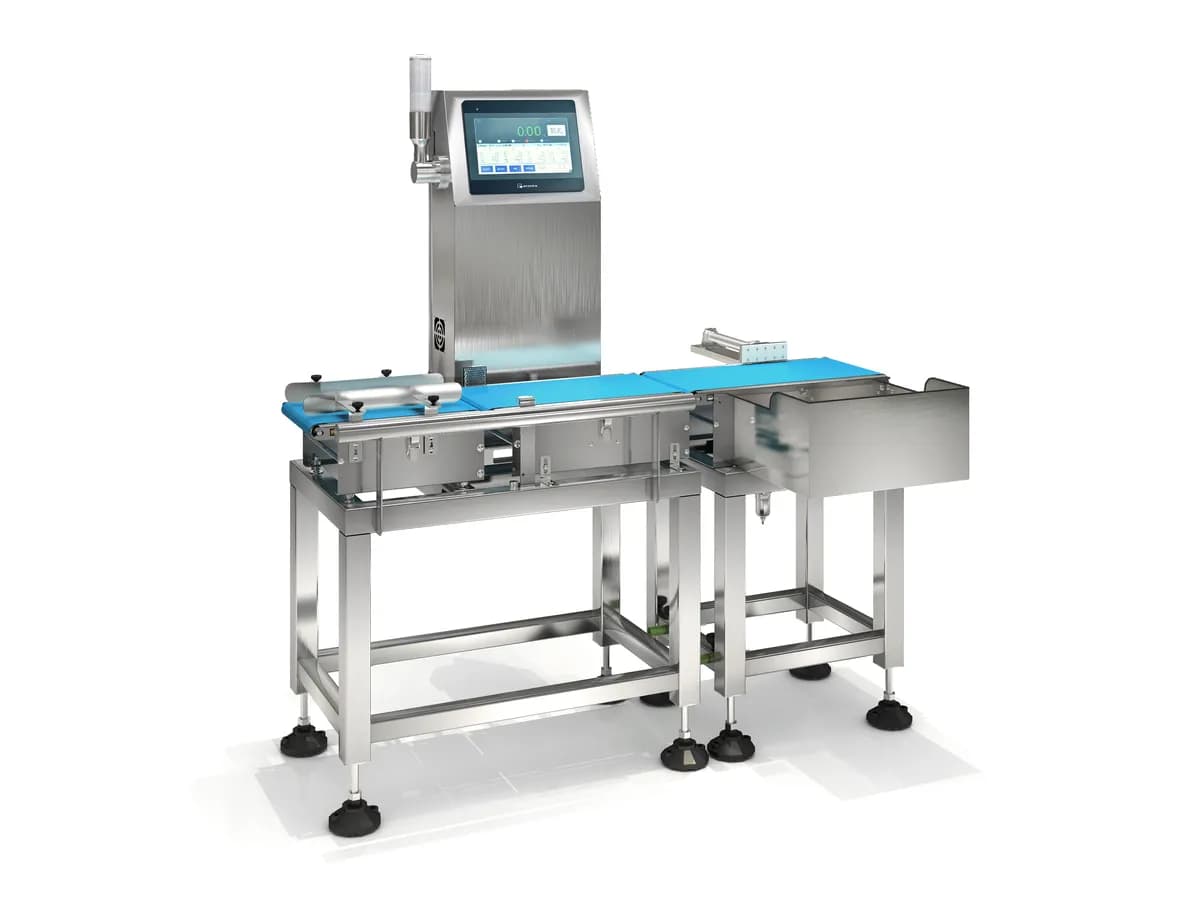
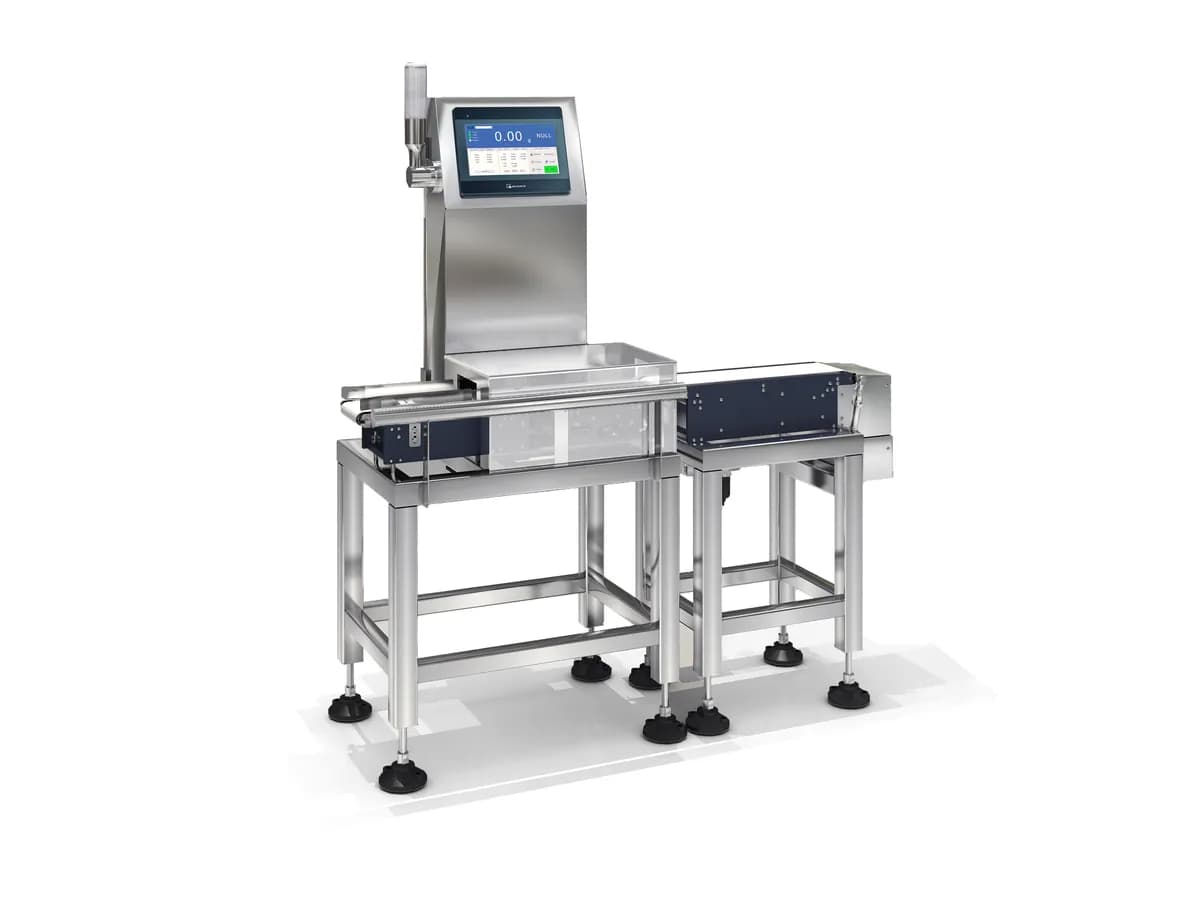
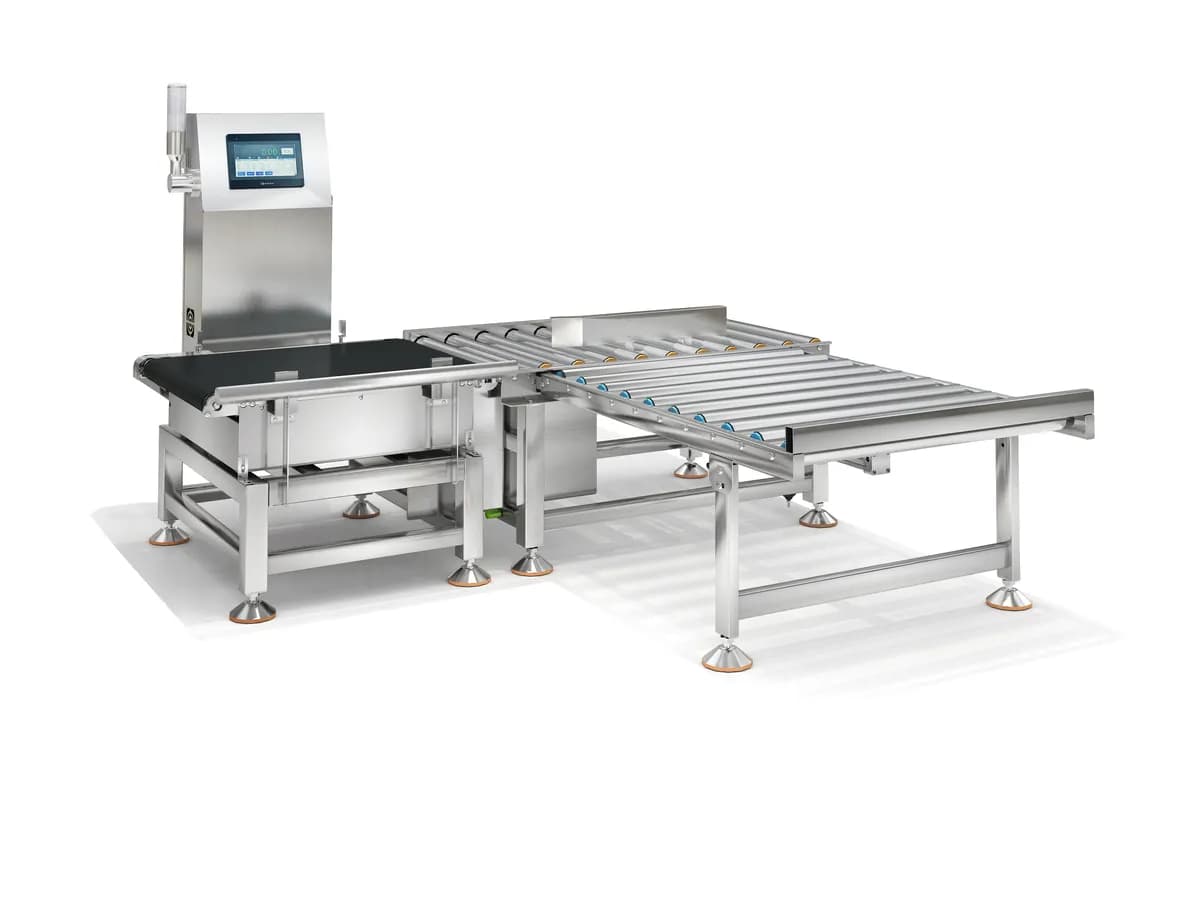
How Does a Checkweigher Work? Infeed, Dynamic Weighing and Automatic Rejection
A dynamic checkweigher weighs every moving pack, compares the filtered result with recipe limits and removes or records exceptions. This engineering guide explains the complete three-stage process, the load-cell signal chain and the line conditions that determine repeatability.
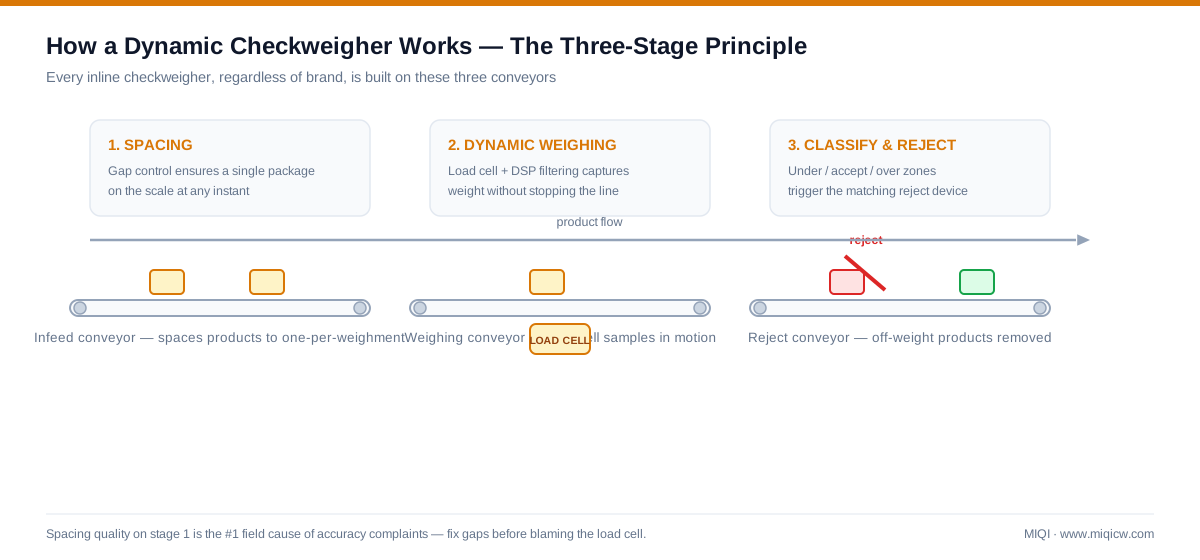
Short answer: an automatic checkweigher spaces a product on the infeed conveyor, measures it while the entire product is supported by the weigh conveyor, filters the load-cell signal, compares the stable result with the active recipe limits, and sends a timed output to the rejector or production-control system. It is a 100% in-line inspection device, not a static bench scale and not a filling machine.
To turn this signal chain into a purchasing specification, compare dynamic checkweigher models for the pack size and load, then use Checkweigher Calibration and Dynamic Verification: A Practical Line Test to verify repeatability and rejection under actual line conditions.
The three stages of an inline checkweigher
1. Infeed spacing and stable transfer
Products must enter one at a time with enough gap for an independent weighing window. The infeed belt matches speed, separates touching packs and transfers them without impact. A high-speed checkweigher cannot recover accurate data if two cartons overlap, a pouch hangs between conveyors or a long product never sits fully on the weigh belt.
2. Dynamic weight acquisition
The weigh conveyor and its load cell convert force into an electrical signal. The controller samples that signal many times while the pack moves through the valid zone, removes vibration and transfer transients, and calculates one result. Actual dynamic accuracy therefore depends on product length, belt speed, floor vibration, airflow, belt tracking and the filtering recipe—not only on display resolution.
3. Decision, rejection and data
The controller classifies the result as underweight, acceptable or overweight. A delay based on belt speed and distance triggers the selected reject device when that exact pack reaches it. The same record can feed counters, alarms, USB exports or an agreed upstream/downstream interface. A missing component detection by weight application uses the same logic: the tolerance window represents a complete kit rather than a declared net-content target.
Checkweigher signal chain
How the checkweigher load cell becomes a result
The checkweigher load cell produces a small analogue signal proportional to force. Mechanical isolation, stable mounting, analogue-to-digital conversion, filtering and the valid weighing window all influence the final number shown to the recipe logic.
| Stage | What happens | Common error source |
|---|---|---|
| Product handling | Space and centre each pack | Touching packs, unstable containers |
| Load cell | Convert applied force to an analogue signal | Vibration, overload, frame contact |
| A/D and filtering | Sample and remove transient noise | Wrong filter for speed or pack type |
| Recipe comparison | Apply under/target/over limits | Wrong product recipe or tare |
| Reject timing | Track the failed pack to the reject point | Wrong distance, speed or confirmation sensor |
Dynamic checkweigher versus static scale
A static scale is usually the better reference for occasional manual checks because the product stops and settles. A conveyor checkweigher is selected when every product must be inspected without stopping production. Its rated performance must be confirmed under real line conditions. Do not compare a 0.1 g display increment on one machine with a dynamic accuracy claim on another as if those figures were equivalent.
What to specify before selecting a machine
- Minimum, nominal and maximum product weight—not only the target.
- Product length, width, height and orientation at the scale transfer.
- Required packs per minute and actual conveyor speed.
- Allowed false reject rate and the smallest meaningful weight error.
- Pack type, stability, moisture, electrostatic behaviour and open-product hygiene needs.
- Reject method, fail-safe confirmation and collection-bin arrangement.
- Required records, recipe control and line-interface signals.
Model values on MIQI product pages are documented equipment specifications. Final dynamic performance is established by a representative sample test at the intended speed and transfer arrangement.
Continue your equipment evaluation
Compare dynamic checkweigher models — ranges, platform sizes, speeds and documented accuracy
Checkweigher calibration and verification — a practical test workflow
Checkweigher reject systems — select the right reject mechanism