
Weighing and Counting Packaging Machine (Packing Machine Series)
Quantitative weigh-count packaging for 200g–5kg hardware parts — fully automatic on a single line, from feeding to labeling and coding.
Weighing and Counting Packaging Machine (Packing Machine Series) (MQ-CP-35) — range 200g-5kg, accuracy 0.5-10g. Factory-direct from Guangdong, China. OEM & custom available.
Typical applications: Quantitative weighing, counting, and packaging of metal parts such as screws and automotive hardware fittings
Key Features
- ✓Ideal for quantitative weighing of metal parts such as screws, hardware, and automotive fittings
- ✓High-precision digital load cell with accuracy up to 0.19; weighing range up to 1-5kg
- ✓Fully automatic operation: feeding, weighing, bag forming and filling, label coding, and conveying completed on one integrated line
Why Choose MQ-CP-35
Gram-level quantitative verification
Weighing accuracy is settable from 0.5–10g by material — small screws counted to the gram, large fittings verified by the bag. A few extra pieces in every bag is money given away; a few short becomes a line stoppage and a complaint at the customer's assembly line. This machine keeps the error at the gram level.
200g to 5kg on one machine
Single-weighing range of 200g–5kg covers everything from small bags of self-tapping screws to 5-kilogram auto-parts service packs, with a 5L hopper feeding continuously. Plants with a wide spec range don't need two machines — one switches between jobs.
Five processes finished on one line
Feeding, weighing, bag forming and filling, coding and finished-product conveying can be integrated to reduce manual handoffs. Confirm the supplied configuration, guarding, replenishment, quality checks and operator workload before planning staffing.
500 recipes, one-touch changeover
Up to 500 product recipes can retain approved settings for repeat orders. Before each changeover, confirm the selected product, target weight, speed and rejection settings and run reference packs. A saved recipe reduces re-entry; it does not by itself prevent mis-selection or remove the need for verification.
PLC control that withstands shop-floor conditions
The listed supply is AC220V ±10%, 50/60Hz. Before connection, a qualified installer must confirm the actual supply voltage and frequency, rated load, earthing, circuit protection and local installation requirements. This specification does not guarantee connection to any ordinary outlet or eliminate site electrical work.
A dosing machine built for metal parts
Designed specifically for the quantitative weighing of screws and metal auto-fittings, it accounts from the selection stage for sharp edges, high density, and jam-prone materials — not a food packaging machine reworked to make do.
Problems It Solves for You
Hand-counting screws into bags, workers count tens of thousands of pieces a day; tired eyes and shaky hands make errors inevitable. Overfilling is material cost given away free every day; underfilling becomes a missing-part line stoppage and a claim at the customer's assembly line.
The catalogue lists 200g–5kg; 0.5–10g. Missing-item detection depends on the missing item's mass, normal product and packaging variation, and measurement uncertainty. Validate complete and deliberately incomplete real packs at the intended speed; weighing alone cannot identify every wrong or missing component.
When orders double in peak season, the bagging, sealing, and labeling stations can't recruit enough people; those trained up are hard to keep, and capacity gets bottlenecked at packaging.
Feeding, weighing, bag forming and filling, coding and conveying can be integrated in one line. The catalogue's stated maximum is 4–6 bags/min, not 4–6 bags per cycle. Actual output and staffing depend on the parts, target weight, bag format, replenishment and verification tasks; confirm them in a sample trial.
Hardware plants easily run hundreds of SKUs; every changeover relies on a veteran manually adjusting parameters — half an hour minimum to set up, and one wrong setting means the whole batch is repacked.
500 preset recipes cover all commonly run items; at changeover, select the product name on the 10-inch color touchscreen to load the full recipe, switching in minutes. Parameters are locked into the machine and aren't lost to staff turnover.
Batch and date information on bags is added manually after the fact or by a bolt-on coder; missed or wrong codes can't be traced, and customers write up non-conformities during factory audits.
Inline coding can reduce a separate handling step, but printed batch and date data must still be verified. Confirm the data source, bag-to-code matching, print readability and the response to missing, incorrect or failed printing before release.
Technical Specifications
| Product model | MQ-CP-35 |
|---|---|
| Weighing range | 200g-5kg |
| Weighing accuracy | 0.5-10g |
| Maximum speed | 4-6 bags/min |
| Hopper capacity | 5L |
| Control system | PLC |
| Preset programs | 500 |
| Power supply | AC220V±10%, 50/60Hz |
| Display | 10-inch color touchscreen |
Functions in Detail
Weighing and metering unit
The catalogue lists 200g–5kg; 0.5–10g. Missing-item detection depends on the missing item's mass, normal product and packaging variation, and measurement uncertainty. Validate complete and deliberately incomplete real packs at the intended speed; weighing alone cannot identify every wrong or missing component.
Parameter and recipe management
Operated via a 10-inch color touchscreen, storing up to 500 product recipes; target weight, speed, fill volume and the full recipe are saved bound to the product name. At changeover, just select and load — parameters stay in the machine, are not lost when operators change, and are easy for managers to review across products.
Bag forming, filling and coding
Inline coding can reduce a separate handling step, but printed batch and date data must still be verified. Confirm the data source, bag-to-code matching, print readability and the response to missing, incorrect or failed printing before release.
Feeding and conveying system
Fully automatic feeding with a 5L hopper; material is conveyed mechanically the whole way from the bin to finished output, so the operator only refills and spot-checks on schedule. Metal parts never pass through hands, avoiding scratches and contamination from manual handling and reducing the risk of sharp edges cutting workers.
Electrical and installation requirements
The listed supply is AC220V ±10%, 50/60Hz. Before connection, a qualified installer must confirm the actual supply voltage and frequency, rated load, earthing, circuit protection and local installation requirements. This specification does not guarantee connection to any ordinary outlet or eliminate site electrical work.
Industries & Application Scenarios
Screws, nuts, and washers are quantitatively bagged for export; from 200g small bags to 5kg large packs, specs switch to the customer's order. Weight verification replaces manual counting, and carton quantities hold up to overseas customers' spot checks.
Weight-based completeness checking must be validated using real complete packs and representative missing-item cases. Product and packaging variation can overlap the missing item's weight. Agree thresholds and verify rejection at the intended speed; a checkweigher cannot guarantee component identity or detection of every shortage.
Furniture-hardware parts can be evaluated for quantitative bagging, with up to 500 stored product recipes. A mixed kit of plugs, connectors and screws is not established by the recipe count: confirm separate feeding or counting where needed and validate the complete component mix with actual samples before agreeing the configuration.
Drill bits, driver bits and other accessory packs can be evaluated for weight-based dosing with inline bagging and coding. Confirm feeding suitability and pack composition with samples. Actual operator requirements depend on replenishment, changeovers, inspection and fault handling, rather than a guarantee of no temporary packing staff.
Expansion bolts, brackets, and small hardware are packed and coded to e-commerce order specs; the machine produces bags continuously with a 5L hopper feeding automatically, so one person watching the machine ships stably in a high-volume warehouse.
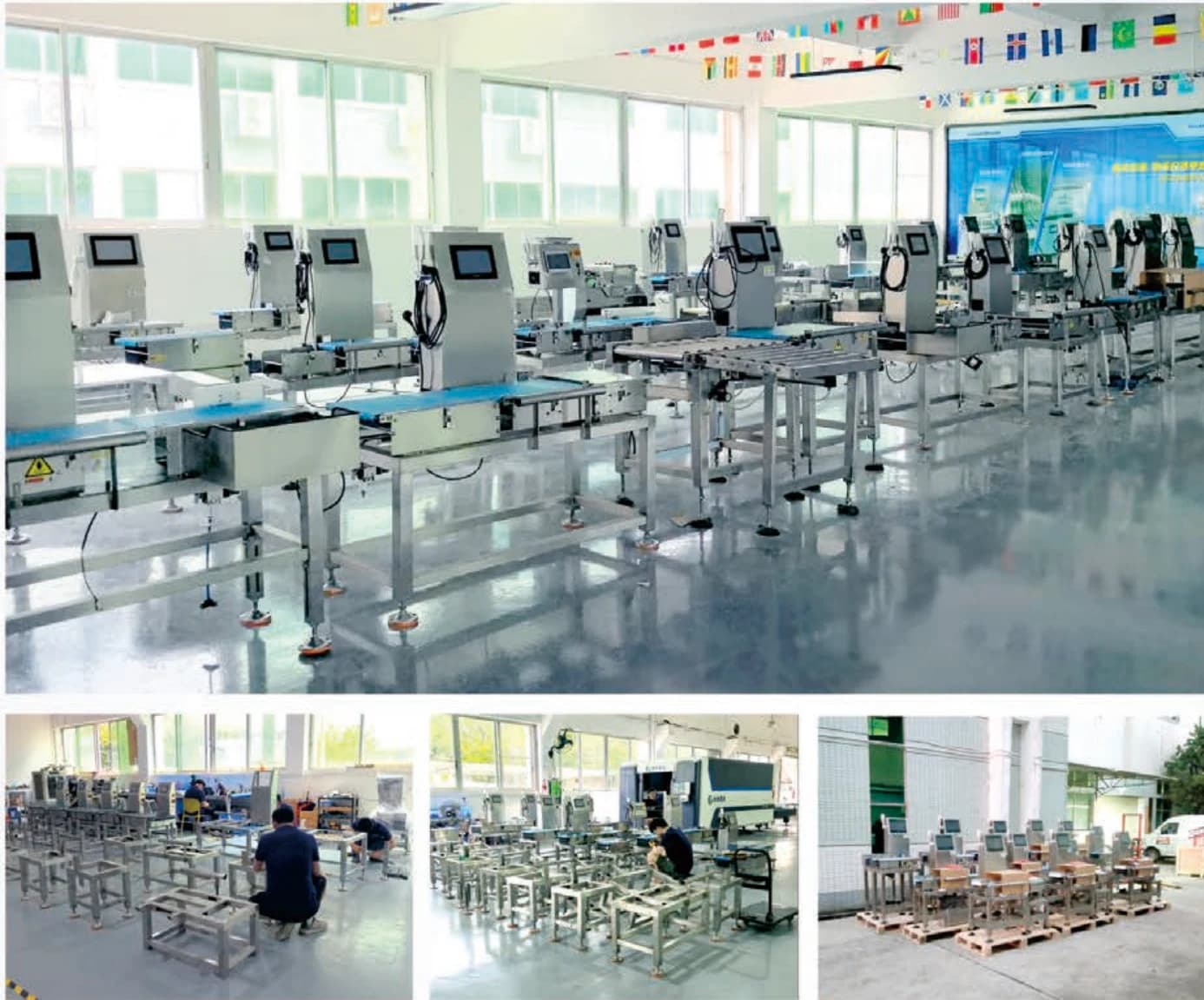
Own Factory · Seeing Is Believing
Guangdong Miqi designs, builds and tests every machine in-house — each unit is bench-tested before shipment. Free sample testing, on-site factory visits and live video of the running machine are all welcome.
Compare this model with other configurations in weighing and counting packaging machines.
Further reading
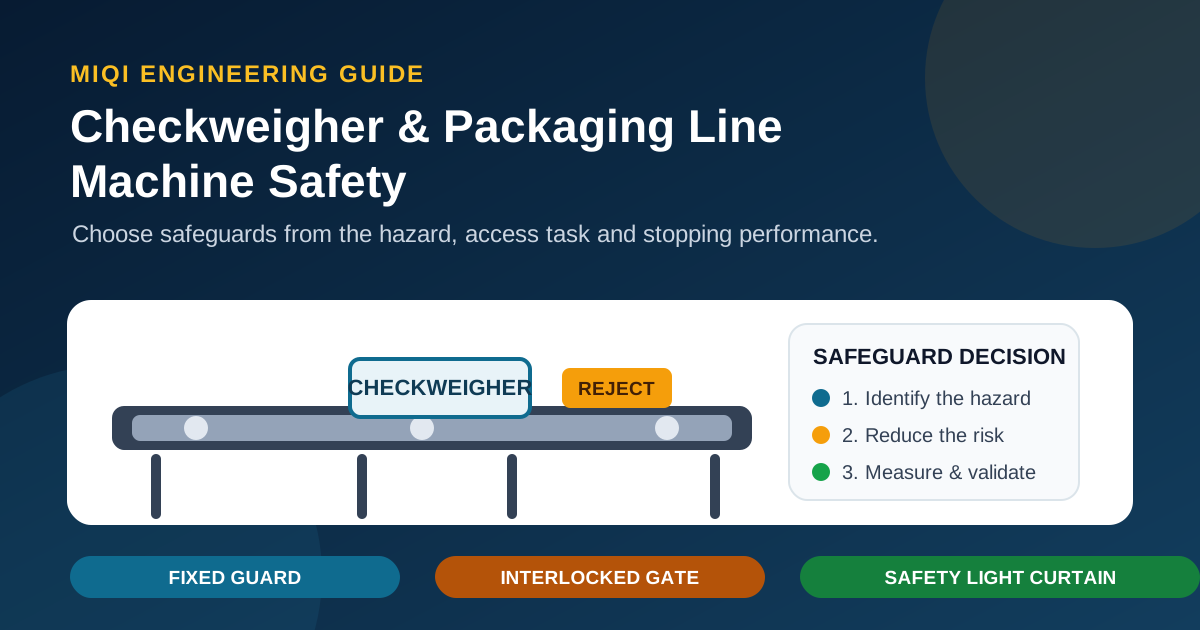
Checkweigher and Packaging Line Machine Safety: Guards, Interlocks or Light Curtains?
A practical risk-assessment guide for checkweigher conveyors, pusher and swing-arm reject stations, collection bins and packaging-machine interfaces. It explains when to use fixed guards, interlocked gates, guard locking, safety light curtains or area detection, and what must be measured before commissioning.
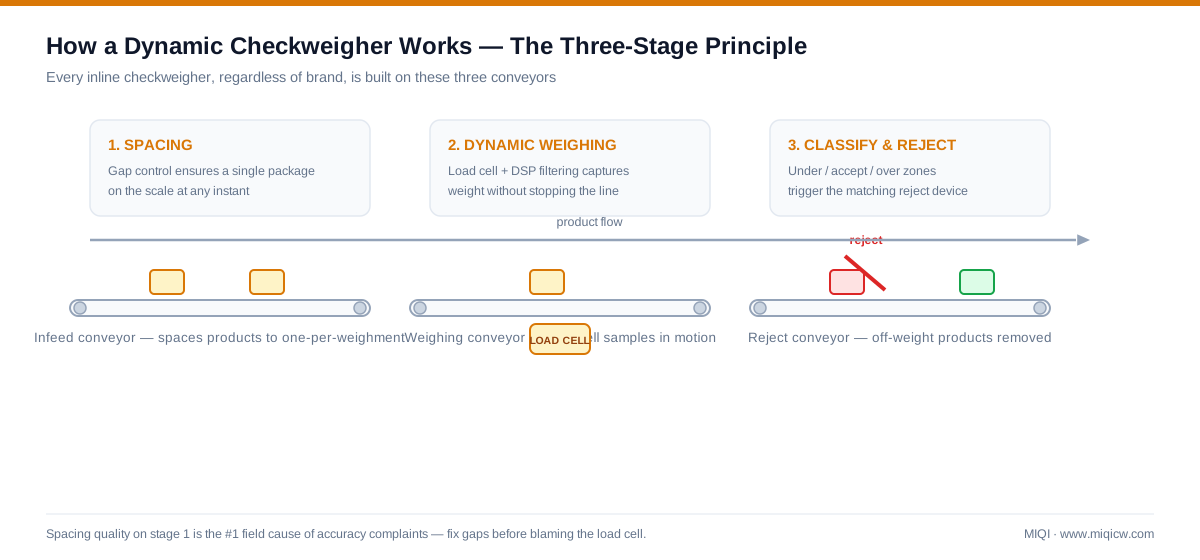
How Does a Checkweigher Work? Infeed, Dynamic Weighing and Automatic Rejection
A dynamic checkweigher weighs every moving pack, compares the filtered result with recipe limits and removes or records exceptions. This engineering guide explains the complete three-stage process, the load-cell signal chain and the line conditions that determine repeatability.
Frequently Asked Questions
What is the price of Weighing and Counting Packaging Machine (Packing Machine Series) (MQ-CP-35)?+
Pricing depends on the weighing range, rejection method, conveyor dimensions and selected options. Send the product weight, dimensions and line speed for a factory-direct quotation.
Does MIQI export Packing Machines worldwide?+
Yes. MIQI ships worldwide with export packing, operating documents, configurable voltage and remote commissioning support. OEM branding and application-specific engineering are available.
Tell Us About Your Product
Share your product weight range, dimensions and line speed — our engineer replies within 24 hours with model recommendation and quotation.